Popular Posts

Sunday, May 19, 2013

Pentecost

The Descent of the Holy Spirit
Since today is the Feast of Pentecost, I felt I should talk about this day. Some history and other general stuff should suffice I think.

There are some important events that happened on Pentecost. For one, Pentecost is the official start of the Church in 33 AD. It was the day on which the Holy Spirit descended upon the Apostles (and Mary) as tongues of fire which gave them the strength to begin spreading Christianity. It is pretty important feast.

During this day, the Apostles were still stuck in the Upper Room waiting for the Holy Spirit to come. It was a very nerve wracking time as the Apostles were worried that they would die just like their Lord. When the Holy Spirit came upon the Apostles, they were filled with the strength to preach to the crowds that were coming into the city due to the Jewish feast. In fact, it was because of this festival that so many Christians were baptized on that very day. Due to the gift of tongues given by the Holy Spirit, they were able to communicate to all peoples from varying lands. It was a really great day for the Church.

Now in the modern era, the Church calendar still celebrates this feast on fifty days after Easter (well roughly since it will be on the closest Sunday). Since the day commemorates the Holy Spirit's descent, the liturgical color for this day is red instead of white. Also this feast is one of the most well-known examples of Confirmation as the gifts of the Holy Spirit were given to those in the Upper Room; one of the most famous gifts, the gift of tongues, displayed before the crowds leading the conversion of many. The Descent of the Holy Spirit is also the 3rd Glorious Mystery as well for the Rosary. 

God's Glory

"Gloria Dei est vivens homo." This is latin for "the Glory of God is the living man" a quote originally stated by Saint Irenaeus.  This is a statement which most people interoperate as "The Glory of God is man FULLY alive" This is because God wanted for us to live the best that we can and that is our true goal to please our Father.

But what does "The Glory of God is man fully alive" really mean? Well this means that each of us have calling, something which God calls us to do. Have you ever had that feeling that whatever you do not satisfy you enough as you would like? Well this is because you are not really being fulfilled. The only thing which can fulfill us is God, and if we don't move toward God calls us to do we are not living as fully alive. Because of Original Sin no man can be fully alive. Original Sin gave us the consequences of clouding our judgment and limiting will; therefore, no man can truly achieve call calls him to do.

Not being able to and not trying are two different things. Just because we fail at something doesn't mean we can't get close to achieving it. We must always strive to do what God calls us to do and eventually we might get very very very close, enough to be called that we are "fully alive". This is not mean that everyone should go become a priest. But we should all do what God calls us to do. Like if you are called to be a priest and become a priest. But if you're being called to be a surgeon or a accountant or lawyer then you should be what God calls you to do. 

We must always strive to do what we can please God. We must please Him and love Him. Simply the glory of God is man doing what God called for us to do and therefore live full lives in God.

Saint Ignatius Of Loyola

St. Ignatius of Loyola was a Spanish knight from a local Basque noble family, hermit, priest since 1537, and theologian, who founded the Society of Jesus (Jesuits) and was its first Superior General. Ignatius emerged as a religious leader during the Counter-Reformation. Loyola's devotion to the Catholic Church was characterized by absolute obedience to the Pope.

After being seriously wounded in the Battle of Pamplona in 1521, he underwent a spiritual conversion while in recovery. De Vita Christi by Ludolph of Saxony inspired Loyola to abandon his previous military life and devote himself to labour for God, following the example of spiritual leaders such as Francis of Assisi. In September 1523, Loyola reached the Holy Land to settle there, but was sent back to Europe by the Franciscans.

Ignatius and a few followers bound themselves by vows of poverty, chastity, and obedience. In 1539, they formed the Society of Jesus, approved in 1540 by Pope Paul III, as well as his Spiritual Exercises approved in 1548. Loyola also composed the Constitutions of the Society. He died in July 1556, was beatified by Pope Paul V in 1609, canonized by Pope Gregory XV in 1622, and declared patron of all spiritual retreats by Pope Pius XI in 1922. Ignatius' feast day is celebrated on July 31. Ignatius is a foremost patron saint of soldiers, the Society of Jesus, the Basque Country, and the provinces of Guipúzcoa and Biscay.

St. Ignatius lived a very amazing life, from his career as a soldier and as a priest through his conversion and life as a priest. Ignatius never truly stopped being a soldier. He just instead of fighting for the kingdom of the Spanish king he fought for the kingdom of God. He swears allegiance to the King's representatives in the world, the pope. The Jesuits are the only religious group in the world who swore allegiance to the pope. He is an incredible role model for Jesuits and non-Jesuits alike.

Saturday, May 18, 2013

Man Fully Alive

Today we'll examine the quote: "The Glory of God is Man Fully Alive" originally stated by St. Irenaeus.

Well certain things come to mind when the question is asked. What is 'Man Fully Alive'? Well it seems redundant and circular reasoning to say that it is the glory of God. That would lead us nowhere. So let's break it down bit by bit.

Man fully alive seems to suggest man being in the absolute state of doing what it was created for. The words 'fully alive' give the feeling of some sort of pinnacle, the highest order, a sort of utopia if you will. Well I would say then that to achieve this would be do fulfill what man was created for. That would certainly bring about a fullness withing one's self since man would be achieving its purpose. Now what exactly is that purpose?

Our very purpose is deeply written within our hearts. Due to natural law, we were born to be united back with God in Heaven. So to achieve being fully alive we would have to get to Heaven, but how exactly? Well, it would be doing what God wants us to do. Everybody is called to follow God's will; it is the universal call to holiness. Anyone can follow this in his/her own daily life. Whatever the vocation may be, all men are to serve one another to aid each other to get to Heaven.

Now let's look at the first part of the quote, "The Glory of God." Obviously this does not state that God is anything less than perfect. By the very definition, God is omnipotent, omniscient, etc. God is perfection itself. However, the glory of God is something that must be seen. Some people may never come to know God. The Glory of God is revealing Him to the world. This "glory" is the outward showing of God's existence upon the world.

Now to combine the two. "The Glory of God is Man Fully Alive." These two things together make a deep, profound statement. When man follows the will of God through his/her own universal call to holiness, the glory of God continues to spread. Also, man fulfilling his role in life manifests this glory upon the world linking people even closer to God.

The Glory of God is the visible manifestation of achieving the pinnacle point of what man was intended.


Wednesday, May 15, 2013

St. Isidore the Farmer

St. Isidore the Farmer
Today we celebrate the Feast of St. Isidore the Farmer.

He was born in Madrid, Spain during the 2nd half of the 12th century. When he was young, he was hired by John de Vergas, a rather wealthy man, to work on his estate outside of the city. While there he married his wife, St. Marie de la Cabeza, and also had a child whom died still a child.

St. Isidore was an extremely devout religious man. He would get up in the mornings to go to church and even used his holidays from working to go to famous churches across Madrid. Even during his task of working as a farmer, he always prayed to God. His dedication towards God was so great that he often showed up late because of lingering at church for a long time. It is also said that he received many visions and that angels would help him during his work in the fields. He was also known to be a miracle worker in that he gave a miraculous amount of food to the poor. He also good with animals due to his time on the farm.

He died on May 15, 1130 which is why his feast day is today. Something interesting too is that he was canonized in the year of 1622 along with St. Ignatius of Loyola and Francis Xavier. Due to his work he is the patron saint of farmers, Madrid, and even the United States National Rural Life Conference.

Saturday, May 11, 2013

St. Ignatius of Laconi

St. Ignatius of Laconi
St. Ignatius of Laconi was born to a family of poor farmers in Laconi, Italy on December 17, 1701. Around the age of seventeen, he grew very ill to the point where he promised he would become a Franciscan if he became healed. After his malady disappeared, his father convinced him to wait. A few years after that, he almost died when he lost control of his horse until strangely it stopped and trotted on peacefully. This was a sign to Ignatius that this was divine intervention from God that saved him. Immediately following he fulfilled his promise of joining the Franciscans.

As a Franciscan brother, he did not stand out. Fifteen years of life went past while he worked in the weaving shed. After that, for forty years he became part of the order that was responsible for asking the people for donations for upkeep of the friars. It was during this time that people started growing attached to him. Ignatius comforted the sick and gave happiness towards the lonely. He was able to convert many men and offered terrific advice to those in sin. The people were so attached that they would wait for his visits.

This did not mean that there were always good days. Some people would reject him by slamming the door on him. Sometimes the weather was bad. There were miles of road to walk through everyday too. Through all this turmoil he persevered. However, there was one house that he would always skip. It was the house of a rich moneylender who made the poor return more money than they had. When this man told Ignatius's superior about this, the superior tasked him to go to the moneylender's house. He did not speak but followed. When he returned with a bag of food, God performed a miracle. The bag, when it was emptied, let loose blood dripping out. "This is the blood of the poor," Ignatius said. This led to all the friars to pray for the conversion of this moneylender's soul.

Ignatius died on the on May 11, 1781 at the age of 80. Pope Pius XII  canonized him as a saint in the year 1951.

Thursday, May 9, 2013

Saint Juan Diego

Juan Diego Cuauhtlatoatzin or Juan Diego (July 12, 1474–May 30, 1548) was a 16th century indigenous Native American from Mexico who said he saw a Marian apparition in 1531 now known as Our Lady of Guadalupe, also known as Virgen de Guadalupe. The apparition has had a significant impact on the spread of the Catholic faith within Mexico. The Catholic Church canonized him in 2002 as its first indigenous American saint.
Altar Basilica of Lady Guadalupe

News of the apparition on Tepayac Hill spread quickly through Mexico; and in the seven years that followed, 1532 through 1538, the Indian people accepted the Spaniards and 8 million people were converted to the Catholic faith. According to Daniel Lynch, director of the Apostolate of the Missionary Image of Our Lady of Guadalupe, "An amazing thing happened. Indians became reconciled to Spaniards. And we had a new race of people. Mixed blood. We called them "Mestizos". Our Lady of Guadalupe had appeared as a Mestiza. They call her the dark virgin, the little brown one.
Our Lady of Guadalupe, as the Virgin Mary came to be known in this context, still underpins the faith of many Catholics in Mexico and the rest of Latin America, and she is recognized as patron saint of all the Americas. Interestingly, the years 1532 to 1538, which saw a large number of people join the Catholic Church in Mexico based on Juan Diego's vision, were right in the midst of the period of Protestant Reformation in Europe. Hence, as a large number of people left the Catholic Church in Europe, a large number of new Catholics appeared in Mexico, maintaining the overall strength of the Catholic Church. To this day, Latin America remains a major pillar of the Catholic Church.

Juan Diego was canonized by Pope John Paul II on July 31, 2002. Pope John Paul II praised Juan Diego for his simple faith nourished by catechesis and pictured him (who said to the Blessed Virgin Mary: "I am a nobody, I am a small rope, a tiny ladder, the tail end, a leaf") as a model of humility.
"I am a nobody, I am a small rope, a tiny ladder, the tail end, a leaf" -Juan Diego

Wednesday, May 8, 2013

Thought On the Homeless

A moving video posted on YouTube nearly a year ago is starting to get viral play now as the social news site Reddit is seeking out the homeless man it features, giving an honest account of what it feels like to be on the streets, looking for a job and to be called a bum. Ronald Davis of Chicago says in the video that he has been homeless for about a year and a half. The video was posted in July, so he has been homeless for at least two years now. He doesn't say why. He has slept under bridges, in cardboard boxes and on benches when he doesn't have enough money for the flophouse, a place where it costs $16 for 24 hours.

"I go fill out applications for a job and stuff. They look at me, you know, I'm not looking presentable and they 'well, we'll call you. Leave a number.' But how can I leave a number when I don't have a phone?" Davis says. It is interesting to me how this is a cycle in which it's very hard to leave. Davis lost his job and he did not have enough money to buy a suit in which he will eventually get a job. It is sad how most people take these people for granted, including myself. We must learn that behind every "bum" there is a depressing story in which we must learn to give. I'm not saying to give these people money every time you see them but maybe give them an opportunity give them hope maybe a job that you know of or a suit that you no longer wear. It makes a very big difference to them!

Next time you see a homeless man remember about Ronald Davis and treat him or her as if is he or she was a friend of yours. At the end he is your brother or sister. We are all children must God and we must treat each other as brothers. It is hard but we must. For it is God's will for us.

Tuesday, May 7, 2013

For the Homeless

This topic is a very important to the everyday Christian. Christians always talk about doing the charitable things, yet there are always things that get in the way of helping a fellow brother/sister in Christ.


To get an idea what I'm about
to talk about please look at this
 video on the right.

Now in today's society, most people tend to ignore the man on the street. Sure there are Good Samaritans everywhere, but the vast majority tend to just ignore them and go along with their everyday lives. Now I doubt people would just completely ignore someone who needs help, but there are always factors which separate them from ever lending an aid. For some people, whenever they donate money to the guy on the street, they find out the guy just ends up buying something like beer which kind of defeats the whole purpose of helping them. Then there are parents who tell their children to stay away due to concern over safety, staying clean, etc. Then there is also the stigma against these people as well. They are the 'unclean' of society; they are mostly made up of bums. However, stereotypes are stereotypes. Not all of these people are bums. There are good people with different stories to tell, so what is it our right to judge them? If we are Christians, we should always strive to help out the person on the street and be a support. That is something any ordinary person can achieve.

Even if we get past the whole boundary of helping these people, is it really a never ending cycle? People complain about these poor people being bums who do not want to get a job. That right there might be the misunderstanding. Sure there might be people who actually are bums, but would it not be hard for someone on the street to actually find a job. In this economy/society especially, it is hard to find jobs even if you look presentable and have a good resume. How hard do you think then would it be for the homeless person? It is because of this that leads into the cycle of giving aid to these homeless people without end. If we could give some sort of training or job then most of the good homeless people would be able to start supporting themselves. Then they would also be able to help contribute to society like they would wish to do.

It is one thing to say that we are Christians, and it is another to actually live as Christians. Even as simple as aiding the people under highways or on street corners is one way everyone can help spread the message of God. Do not let some sort of stigma from society affect how you can help out? Who knows, maybe that person who you just helped might help you back in the future? Either way, everyone is human and we each have a human dignity. To accept that means to do your part in helping things get better.

Monday, May 6, 2013

All are Welcome?

Okay so this post relates to my last post on the Woman Ordained as Priests
(see here: Woman Ordained as Priest?)
This time the question is "Is everyone truly welcomed into the Church?" (see this post here: All are Welcome?)

Now we should all know by now that the Catholic Church invites everyone to join them. Since Christ instituted the Church, any person is invited to join regardless of race, gender, etc. There is no discrimination between members since it is universal. This also leads into some major confusion however. Some people think it is unfair/incorrect for a group of people to say that all are welcome, but there are a bunch of rules to be followed.

Let me explain. First to get an idea, you could look at some of the comments to the article above. Some people hate the fact that all are welcome, but there are rules/regulations that the Church states. The Church does accept people that are homosexual, woman that are struggling with rape and leaning towards abortion among many of the more influential topics of today's society. This however does not change the fact that the Church will just accept the sin. The Church prays for the person with this condition, however the act in itself is only for a male and female. Even though the woman who was raped now has a child, all life is precious. Aborting the baby is killing. Even though there might be extenuating circumstances, this does not change some fundamental beliefs.

Here's what the real problem is in society. There are too many people who want to be a 'god.' Instead of conforming to God, they take the sin of pride and say that God should conform to them. In the case of the female ministers, they blame the Church because they look at the role of priesthood as an occupation rather than a vocation. Even though they might seem similar in terminology, they are different. An occupation is a job, but a vocation is a role that God calls you too. These people who do not accept this fact basically state, "I choose to ignore God and will do what I want." Sure these people may have the right heart, but it does not change the fact that they are slapping God in the face by choosing to go against him. Instead of looking at this objectively, they take everything personally and go with the flow of society. Instead of conforming to God, they choose to turn away from him by being better than him. This same fault can be seen all across the ages including the beginning with Adam and Eve. They wanted to be 'gods' so that they could be better than God. They freely chose to eat from the tree. Even though the times have changed, this same sin continues to burden society.

The Church does in fact accept anyone. Just don't go making the Church follow your own beliefs. If you want to point out flaws, go talk to the Church officials instead of just raging and abandoning your faith. If you so easily abandon it, either you lacked faith or you just did not care. There is always a reason, so be patient. Follow the will of God and you will find the truth.

In the end I veered off topic, but I do hope whomever reads this takes this to heart.

Saturday, May 4, 2013

Women as Priests

This topic has been gaining ground across America and across the world. Should women be priests?

First, this article might help give some insight into the debate. Woman ordained as a priest

Okay I hope you read the article, because now it's time to get some thoughts out. Obviously the main debate is that Catholics feel there is an injustice in that the Church will not allow women priests. Now discrimination of gender is obviously bad, but this is not what God wanted.

Now how do we know this? Well, Christ himself chose twelve men who became known as the Apostles. Jesus created this hierarchy for the means of salvation to the world. The Church, which was instituted by Christ, cannot willfully disobey God's command.

The debate on this topic now comes largely in part due to Christ having female disciples that acted out higher roles. They delude themselves into thinking these famous Christian females were priests or deacons. This, they feel, gives further credibility for women priests. Also, these people feel that the Church should allow it to keep up with the modern era (this topic also leads into debates on abortion, birth control, and same-sex marriage). They say that Christ held no qualms against women, and they were even some of his closest disciples. They say Christ obviously only followed the customs of old (as in the time) which is why he only chose males.

Now for the Catholic's side. First off, most of this debate I personally find funny since these same people keep giving a double standard. They want the Church to modernize by changing some of its infallible decrees, yet they also critic on the Church on supposedly continuously adding new teachings that never should exist. The Church, because Christ chose twelve men and no women, only allows the sacrament of Holy Orders to be given out to men because that is how Christ instituted it.

It is also true Christ had close disciples in women, but stating that women were not chosen because of society is entirely untrue. Since when did Christ conform to society? Christ only obeyed the will of the Father and thus obeyed some Jewish customs too. However, when did Jesus allow himself to be stopped by society? He frequently stayed with the sinners, which is not at all conforming to society. He had some of the more unintelligent lot become Apostles. He even had a tax collector be one of his closest members whom everyone hated. If he wanted to, he would have chosen females to enter as Apostles. Since he did not, there must be some reason for it.

For those Catholics who still think that women should be ordained as priests, well you are entitled to your own opinion, but I would then say you are deluded in your beliefs. It may sound chauvinistic since a male is writing this, but it is either accepting this and staying with the Church Christ instituted or schisming from the Church. I for one will stay with the Church Christ instituted. None of us can declare what is right in the Church without the will of God, and I for will stay on that side.


Friday, May 3, 2013

Eucharistic Miracle: Lanciano, Italy 8th Century A.D.

One day in the eighth century, in the church dedicated to Saints Legontian and Domitian in Lanciano, a Basilian monk was celebrating Holy Mass in the Latin rite, with a host of unleavened bread. The monk started doubting the real and substantial presence of the Flesh and Blood of Our Lord Jesus Christ in the consecrated Holy Species. After having pronounced the words of Consecration (“This is My Body... This is My Blood”), as Jesus had taught it to His Apostles, the monk saw the host change into a living piece of Flesh, and the wine change into real blood, which thereupon coagulated and split into five globules, irregular and differing in shape and size.

The Host-Flesh, as can be very distinctly observed today, has the same dimensions as the large host used today in the Latin church; it is light brown and appears rose-colored when lighted from the back. The Blood is coagulated and has an earthy color resembling the yellow of ochre.

During Sunday mass, the same thing takes place. The Church teaches that although the accidents(the visual aspects)  remain the same the core of the substance changes in a process called transubstantiation. Transubstantiation is the process in which the bread and wine changes to flesh and blood. This process is usually internal, yet in this case the process was visual for the doubting monk to see.

It is impressive to me how God gives us answers to everything. If one doubts the real presence, he proves it.  God loves all of us and wants us to prosper! We should not take for granted the miracles that take place in our everyday lives: a bird singing; the sun rising; etc.... God gives us what we need when we need it, let us ask for nothing more!

Wednesday, May 1, 2013

The Seven Sacraments with Human Nature

The Seven Sacraments are a way of receiving Sanctifying Grace,grace has been defined as "the love and mercy given to us by God because God desires us to have it, not because of anything we have done to earn it the condescension or benevolence shown by God toward the human race It is understood by Christians to be a spontaneous gift from God to man - generous, free and totally unexpected and undeserved - that takes the form of divine favor, love and clemency.  Christ wishes for us to be saints and live for eternity with him. This is why he created the sacraments, so we can attain the grace necessary for salvation.  Christ make salvation available to us through the sacraments.

Have you ever felt like no matter what you do you just don't fell fulfilled? That is you body's longing for Christ. It is in our nature to seek for God. The sacraments are necessary tools for our salvation. They grant us the grace necessary for our nature to be fulfilled. So next time you have a longing for something, go to mass!

Tuesday, April 30, 2013

Catechumenate

The Catechumenate is the process for all those who wish to become members of the Church. Likewise, the person who is called a Catechumen while the community of such people and the actual time period until Baptism is called the Catechumenate. It originates from a Greek word which means 'learner.' This process is an undergoing of instruction and teachings of the Faith and preparation for the Sacraments of Initiation.

The original purpose of the process was to give a sort of first step in order to convert into Christianity. There has to be a time period in which people who willfully enter the Church must undergo instruction to properly know about the Faith. The Catechumen must understand what it is that entering the Church entails. Normally this process happened by initiating members at Easter Vigil, the night before Christ rose from the dead. This process then became restored by Vatican II in the process of RCIA (Rite of Christian Initiation of Adults).

Baptism by immersion
To understand this, we need to understand the Rite of Baptism. The entire Rite contains the actual pouring of water, a re-commitment of baptismal promises, a white candle, and white garments. The water not only symbolizes cleansing but taking part in the Paschal Mystery. This can be seen by Baptism through immersion since the person immerses himself/herself under the Holy Water and "rises again" to new life.

While the Eastern Rite gives out all three Sacraments of Initiation in a row, the Latin rite is somewhat different. Normally, a child of the Latin rite would be baptized as a baby. Once that child reaches the age of reason (meaning seven years old), they typically receive Eucharist. When they become older (middle school through high school [leaning towards high school]), the person finalizes his/her initiation by receiving Confirmation.

What about those who become baptized later?

This is where RCIA comes in. Since the Baptism is necessary for salvation, people must enter this process. RCIA is for all older minors and adults who have not received their initiation Sacraments. However, unlike those going through the standard route, anybody who takes RCIA follows the same school of thought by receiving all three Sacraments consecutively. The Catechumen will go through the process, listening to the Word of God, forms of prayer, etc. When they are ready to receive the Sacraments of Initiation, they will be baptized on the Easter Vigil Mass through a special ceremony on that day.

So it is never too late to be saved be saved. Anyone who wants to enter the Church under the right attitude can join the Church.

Sunday, April 28, 2013

Saint Andrew

Saint Andrew was one of the 12 apostles. He is patron saint of fishermen, for he was a fisherman. He became a disciple of the great St. John the Baptist, but when John pointed to Jesus and said, "Behold the Lamb of God!" Andrew understood that Jesus was greater. At once he left John to follow the Divine Master. Jesus knew that Andrew was walking behind him, and turning back, he asked, "what do you seek?" When Andrew answered that he would like to know where Jesus lived, Our Lord replied, "Come and see." Andrew had been only a little time with Jesus when he realized that this was truly the Messiah.

After the death of Christ, St. Andrew went to Greece to preach the gospel. He is said to have been put to death on a cross, to which he was tied, not nailed and it is believed that it was in the shape of an X for he believe to be unfit to die the same way Christ died. He lived two days in that state of suffering, still preaching to the people who gathered around their beloved Apostle. Two countries have chosen St. Andrew as their patron - Russia and Scotland.

Saint Andrew is without a doubt my favorite Saint. Most apostles lived non religious live previous to meeting Christ, but Saint Andrew was a follower of John the Baptist. He lived an inspiring life! Who is willing to suffer for 2 days straight for the faith of a dead person.


From everyone who has been given much, much will be demanded; and from the one who has been entrusted with much, much more will be asked. -Luke 12:48

Saturday, April 27, 2013

St. Lorenzo Ruiz

St. Lorenzo Ruiz- 1st Filipino Saint
Saint Lorenzo Ruiz is one of the most widely regarded saints in the Philippines. He is the first Filipino saint and the first one to be martyred for his faith as a Catholic. 

He grew up in Manila around the 1600s and was taught under a Dominican schooling. He was very active in his faith during Masses as he grew up as an altar server and then moved up into a clerk-sacristan. He also joined the Confraternity of the Rosary. He earned his keep as a calligrapher meaning he was highly educated since during this time period, many were not even close to achieving greatness in this art. 

Some time later, he was accused of being involved in a criminal case (whether this was true or not was unclear). Due to this, he fled to Japan which was currently persecuting Christians. He was incarcerated along with his comrades. He was violently persecuted, but St. Lorenzo stayed steadfast in his faith and persevered and even told them that he was ready to die for the faith. He was hung by the gallows from his feet on September 27,1637. His body fell into a pit from this fall. He died of suffocation and bleeding after managing to hold on for two more days. 

Pope John Paul II beautified him along with his companions on February 18, 1981. They were all canonized on October 18 of that very same year. They all share the same feast day of September 28.

Tuesday, April 23, 2013

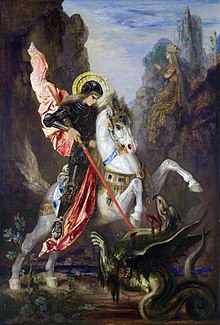
Mother Night: St. George and the Dragon

During an assignment I have to do for English, I read Kurt Vonnegut's novel Mother Night. During it I came across a chapter called called "St. George and the Dragon." I was immediately struck by curiosity for I did not know what this novel was referring to, so I decided to investigate.


The episode Saint George and the Dragon appended to the hagiography of Saint George was Eastern in origin, brought back with the Crusaders and retold with the courtly appurtenances belonging to the genre of Romance. The earliest known depictions of the motif are from tenth- or eleventh-century Cappadocia and eleventh-century Georgia; previously, in the iconography of Eastern Orthodoxy, George had been depicted as a soldier since at least the seventh century. The earliest known surviving narrative of the dragon episode is an eleventh-century Georgian text.
The dragon motif was first combined with the already standardised Passio Georgii in Vincent of Beauvais' encyclopedic Speculum Historiale, and then Jacobus de Voragine's Golden Legend (ca 1260) guaranteed its popularity in the later Middle Ages as a literary and pictorial subject. The legend gradually became part of the Christian traditions relating to Saint George and was used in many festivals thereafter.

St. George story is incredibly interesting and I hope you enjoyed it as much as me. My theology teacher became of that last week. I ask that we pray for him.

Monday, April 22, 2013

Thoughts on: 'The Church in the Life of the Faithful'

This will not be an ordinary post about saints or specific aspects of the Church in full detail. This will be a post explaining my thoughts on  'The Church in the Life of the Faithful' and all that I believe it entails.

The first few things to come to mind are the following: how does the Church affect the life of the faithful, how do the people respond the Church, how can Christians grow closer to being faithful, etc. Another thing would to actually define the word 'Church' in this case. Does it mean the body of members or does it mean the teaching authority given by Christ.

First off, I would say that this title probably refers to how Christians are called to serve. It is one thing to go to Mass, but it is another to spread the Word of God and follow the words "Ite, missa est" (literally:"Go, it is sent" or commonly known as "Go, the Mass has ended"). Just as the Church has the important role of being the instrument of salvation, it is just as important that the members of the faith grow in holiness and actually spread the faith instead of just going through the motions.

This is not to say that everyone has the same vocation. Even though we are called to holiness, each person also has a specific vocation whether they be a teacher, missionary, brother, sister, etc. Even though we all have a universal call, each person is different.

The title also implies something to do with how the Church celebrates the Mass. I would probably take that to mean the different Scriptures stated every three years through the liturgical years of A, B, and C. It would also imply how the Church celebrates specific Church holidays. Easter and Christmas automatically come to the forefront of my mind.

The last thing I would think would be about the Sacraments. The whole point of going to Church is to grow closer to God by receiving the graces necessary to be saved. I would say that would be an important part of how the Church affects the lives of the people.

Well, these are just my thoughts on the subject matter.

Sunday, April 21, 2013

St. Irenaeus

St. Irenaeus of Lyons
St. Irenaeus was one of the most important people in the early Church to the point he was called one of the fathers of the Church.

He was born circa A.D.125 in a province in Asia Minor. There he   was influenced by another saint, Saint Polycarp. Sometime later he along with many priests and missionaries went to Gaul and formed a local church which would be the foundation of the church of Lyon. He served as a priest there under the bishop St. Pothinus. He was then sent in 177 to Rome. It is because of this that he avoided the persecutions in Lyons. When he got back, the persecution ended and he was sent to be the temporary bishopric.

During this time, Gnostic teachings had spread very far in Gaul. This prompted him to reveal the errors in these heresies. In five books he contrasted these heretical teachings vs. the true message passed on to the Apostles. Originally in Greek, once the writings spread, it was converted into Latin; this ultimately created the finishing blow to the teachings of Gnostics in that Gnosticism never again would be a serious threat to the Church.

It was assumed that his death year is 202 although it is not certain. The tomb/shrine that contained his bodily relics were destroyed by the Calvinists in 1562 making the relics seem to have perished. Although not considered a Doctor of the Church, he was still a pivotal saint that was the major contributor to defeating one of the great heresies of the time making him one of the most important saints in early Church history.

Saturday, April 20, 2013

St. Cecilia

Well today I'm performing for a band concert at my school, and so I got the idea to write about the Patron Saint of music.

St. Cecilia-Patroness of Music

St. Cecilia lived between the 2nd and 3rd centuries in Rome. She was a very holy woman, who prayed to saints and angels alike to preserve her virginity. She was to be married by a young man named Valerian. She told her husband a secret which stated that there was an angel who kept her from harm. When asked if he could see it, she replied to become baptized.

After he was baptized by Pope S. Urban, he found his wife praying in a chamber guarded by an angel with flaming wings holding two crowns of roses and lilies.The angel placed the two crowns upon them and then vanished. Tibertius, Valerian's brother, saw these flowers during that season of the year, he too became baptized.

During this time Cecilia began converting 400 people whom Pope S. Urban baptized. Later, she was arrested and sent to be suffocated in a burning bath. Even though the fires burned their hottest, she would not perspire. After that a man was tasked with beheading her. After the man failed thrice, he left her to bleed to death. While she was bleeding, she converted many people whom also soaked up the blood with sponges or cloths. After that she died and was buried by Pope Urban.

Her feast day is November 22. The reason she is the patroness of music is that when she was compelled to marry her at the time pagan spouse Valerian, she heard heavenly music within her heart. This later grew and much music, art, and several festivals were made in honor of St. Cecilia.